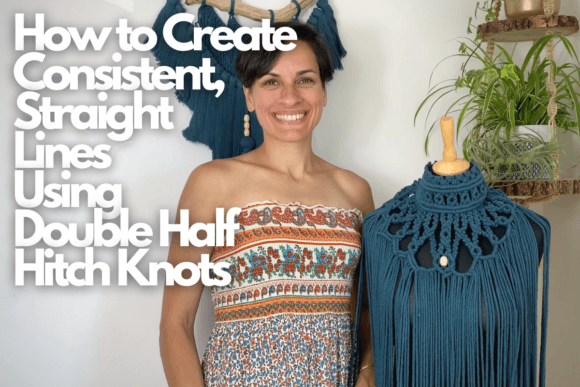
Mastering Double Half Hitch Knots for Perfect Lines
Macrame is more than just a craft—it's a form of expression, a way to create beauty with your hands. One of the most essential knots in macrame is the double half hitch. When done correctly, this knot can create clean, straight lines that are perfect for geometric patterns, wall hangings, and intricate designs. But achieving consistency with this knot can be tricky. This guide walks you through five common mistakes when learning to make double half hitch knots and how to fix them. Whether you're a beginner or looking to refine your skills, mastering these techniques will help you create bold, neat, and uniform lines every time.
The Power of Consistent Lines in Macrame
Consistency is key in macrame, especially when working on symmetrical patterns or repeating shapes like diamonds. Straight, even lines not only enhance the visual appeal of your work but also ensure that your designs look professional and polished. The double half hitch knot is particularly useful for creating these lines because it allows for tight, uniform spacing between each knot. However, many learners struggle with making their lines appear uneven or wavy. Understanding how to correct these issues is the first step toward creating beautiful, structured macrame projects.
Common Mistakes and How to Fix Them
Let’s dive into the most frequent errors people encounter when working with double half hitch knots and explore simple fixes to achieve straight, consistent lines.
1. Uneven Tension in the Knots
One of the biggest problems beginners face is applying inconsistent tension when tying their knots. If you pull too tightly or too loosely, the resulting lines will look uneven and may not align properly with other sections of your project.
- Issue: Knots that are either too loose or too tight.
- Solution: Practice applying even pressure as you tie each knot. Use a steady rhythm to maintain consistency.
- Tips: Keep your fingers close to the knot as you tighten it to ensure uniformity.
2. Misaligned Knots
Misalignment is another common issue. If your knots aren’t placed evenly along the string, your lines will appear crooked or jagged, which can ruin the symmetry of your design.
- Issue: Knots that are spaced irregularly or shifted off-center.
- Solution: Count your knots as you go to ensure they’re evenly spaced. Mark the starting point if needed.
- Tips: Use a ruler or measuring tape to check spacing periodically.
3. Incorrect Loop Placement
The placement of the loop in the double half hitch can affect how the knot looks. If the loop isn’t positioned correctly, the knot may appear lopsided or asymmetrical.
- Issue: Loops that are too high or too low on the string.
- Solution: Make sure the loop sits at the same height on each string. This helps maintain a consistent line.
- Tips: Practice placing the loop at the same position on every string before tightening the knot.
4. Skipping or Missing Knots
It’s easy to skip a knot when working quickly, especially when trying to keep up with a pattern. Skipping knots can cause your lines to become uneven or break the flow of your design.
- Issue: Missing or skipped knots disrupt the structure of your lines.
- Solution: Take your time and count each knot as you go. Use a marker or small dot to indicate where each knot should be placed.
- Tips: Work slowly and focus on accuracy rather than speed.
5. Inconsistent Starting Points
If your starting points for each row or section of your design aren’t aligned, your lines will appear staggered or misaligned. This can be especially noticeable in larger projects like wall hangings or decorative panels.
- Issue: Starting points that are not aligned across strings or rows.
- Solution: Ensure all strings start at the same point and follow the same direction. Use a guideline or marker to help maintain alignment.
- Tips: Use a piece of paper or a ruler to create a reference line for your starting points.
Applications and Creative Possibilities
Once you’ve mastered the double half hitch knot and achieved consistent lines, the possibilities are endless. These knots are ideal for creating geometric patterns, border designs, and even functional items like bracelets or home decor. You can use them to make identical diamond shapes for a wall hanging, create a series of parallel lines for a modern design, or add texture to a larger piece.
For designers and creators, the ability to make precise lines opens up new ways to experiment with color, shape, and structure. Whether you're working on a personal project or designing for clients, having control over your lines gives you more creative freedom.
Adapting the Technique for Different Projects
This technique isn't limited to one type of project. It can be adapted for various formats and audiences. For example, educators can use it to teach basic macrame skills to students, while entrepreneurs might incorporate it into product lines or workshops. Bloggers and content creators can share tutorials to inspire others, and hobbyists can enjoy the satisfaction of creating something unique and meaningful.
No matter your goal, the principles of consistency and precision apply. By focusing on these aspects, you can elevate your work and bring more professionalism to your creations.
Conclusion
Creating consistent, straight lines with double half hitch knots is a skill that requires practice, patience, and attention to detail. By recognizing and correcting common mistakes, you can improve the quality of your work and unlock new creative potential. Whether you're crafting for yourself or sharing your knowledge with others, mastering this technique is a valuable step in your macrame journey. With time and dedication, you'll be able to produce bold, neat, and perfectly aligned lines that enhance any project you undertake.